
8 Bad Things That Happened on My Marrakech to Merzouga Trip

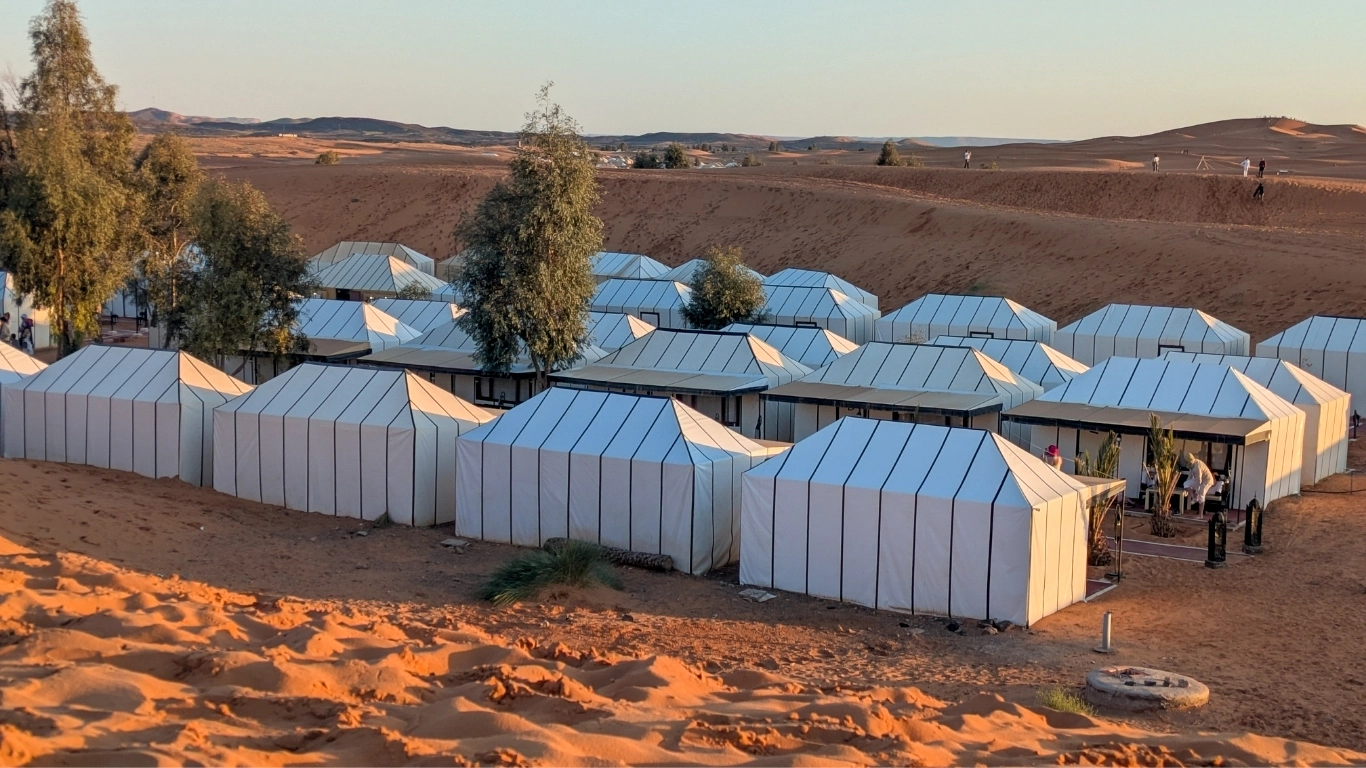
Most travel guides about the Marrakech to Merzouga desert trip will give you a neat itinerary, beautiful photos, and a list of things to pack.
What they won’t give you is the truth.
I’m Ayoub. I grew up in Marrakech, I’ve done this road more times than I can count, and I booked the $70 tour so you don’t have to. Here are seven things — and one crucial planning mistake most visitors make — that the travel blogs consistently skip.
✦Short on time? Here’s everything in 10 seconds.
The Local’s Checklist — Read This Before You Book
⭐ Avoid the $70 budget trap: Budget at least $150 per person. The cheap tours are a mistake I made so you don’t have to.
⭐ Use Waze immediately: Police checkpoints appear roughly every 20 kilometers from the moment you leave Marrakech. Waze is essential to avoid heavy fines.
⭐ Stock up in Marrakech: Buy your snacks and water at a city supermarket. Prices double or triple at roadside tourist stops.
⭐ Ride the camel only once: Take the camel to the camp for the experience, but book a 4×4 or quad bike for the return journey to save your lower back.
⭐ Wake up at 5:30 AM: Sunset is highly rated, but the absolute silence and soft light of a Sahara sunrise is unmatched.
⭐ Book 4 days, not 3: Spending 10 hours in a car for just two hours in the dunes is a bad trade-off. Give yourself time to actually enjoy the Sahara.
Your Phone Signal Disappears Inside the Tent
Local Moroccan SIM cards work reasonably well outside in the desert, but once you’re inside your tent, you’re essentially offline. The signal simply doesn’t reach through the fabric walls the way you’d expect.
If you’re relying on an eSIM, I personally recommend Yesim — the quality is reliable for this trip. It costs under $5, and with the code YesimX you get 20% off.
One practical tip: download your playlists, and anything else you need before you leave the last town. Once you’re in the dunes, assume you have nothing.
Checkpoint Every 20 Kilometers — Use Waze
The road from Marrakech to Merzouga is one of the most scenic drives in North Africa. It’s also one of the most policed. Expect a checkpoint roughly every 20 kilometers — that’s not an exaggeration.
Our tour driver from GetYourGuide swore by one app: Waze. It alerts you before every speed camera and police checkpoint, giving you enough time to slow down and pass through without issues. If you’re driving yourself, Waze isn’t optional. It’s essential.
One traveler in a group I was with got fined twice on the same stretch of road before I told him about the app. That’s 300 MAD that could have stayed in his pocket.
Local Tip: Speaking of keeping money in your pocket, if you are planning to drive this route, don’t risk heavy cash deposits with random agencies. Use Localrent to secure a reliable car with zero-deposit options, and turn on Waze the moment you hit the road to dodge both scams and fines entirely.
The Tizi n’Tichka Pass — Bring a Bag. Seriously.
About two hours into the journey, you hit the Tizi n’Tichka mountain pass — 2,260 meters above sea level, cutting through the High Atlas.
The landscape is genuinely spectacular: sharp peaks, dramatic drops, ancient villages carved into the hillsides.
It’s also two hours of continuous hairpin turns with no flat road in sight.
I personally felt dizzy and genuinely exhausted by the time we descended. I heard about travelers get properly sick in the car.
My advice: bring a small bag or an empty bottle with you — just in case you feel dizzy, overheated, or need a quick place to cool down and rest.
It’s not glamorous advice, but it’s one of those things you’ll either never need and forget you packed, or desperately need and wish someone had warned you about.
If you’re prone to motion sickness at all, take medication at least 30 minutes before this section of the drive.
Everything Doubles in Price at Roadside Stops
The cafes and shops along the route know exactly what you’re thinking: there’s nothing else for the next 50 kilometers. They price accordingly. Water, snacks, a simple coffee, expect to pay double or more compared to what you’d pay in Marrakech.
This isn’t a scam, exactly. It’s economics. But it catches people off guard every time.
The fix is simple: stock up before you leave Marrakech. A small bag of snacks and two or three water bottles from a city supermarket will cost you 30–40 MAD and save you from paying five times that on the road.
The Camel Ride Is Not Comfortable
Those golden-hour photos of travelers on camels, silhouetted against the dunes? That’s real. That moment exists and it’s worth experiencing.
What those photos don’t show is the 20-minute reality of how you get there. The camel’s movement is uneven and rhythmic in a way your lower back wasn’t designed for.
By the time you reach the camp, you’ll understand immediately why the return trip exists as a separate conversation.
My honest advice: ride the camel to the camp. Do it for the experience, do it for the photos — it genuinely earns its place in the trip.
But for the return journey, take the quad bike or the 4×4. Your body will thank you, and you’ll actually enjoy the landscape instead of just trying to stay balanced.
Sunrise Beats Sunset — If You Can Wake Up
Every travel guide talks about sunset in the Sahara. The colors, the silence, the way the light changes the dunes from gold to amber to deep red.
All of that is true. But sunrise is better.
The light is softer and more diffuse. The air is completely still. The silence is deeper in a way that’s hard to explain until you’ve experienced it — the desert at 5:30am feels like a different planet entirely.
And critically, the heat hasn’t arrived yet, which means you can walk further into the dunes without it becoming an endurance challenge.
The catch is waking up before dawn. If that sounds genuinely impossible, sunset is still a magnificent experience.
But if you can push yourself out of that sleeping bag once, just once — do it. You’ll understand immediately why people who’ve been before always mention the sunrise first.
The Desert Gets Cold at Night And Mourning — Even in Summer
This surprises almost every first-time visitor. You’ve been thinking “Sahara” and “heat” as synonymous concepts for so long that cold doesn’t enter the equation.
But once the sun sets, the temperature in the desert drops sharply — sometimes by 15–20 degrees within a few hours. In June and July, nights can still reach 15°C or lower. Travelers who packed only summer clothes genuinely struggled to sleep.
One light warm layer in your bag is all you need. A fleece or a thin jacket. Don’t leave it at the riad convinced you won’t need it. You will.
The 3-Day Tour Isn’t What You Think — Book 4 Days
This is the one that most people don’t realize until they’re already on the road, and by then it’s too late to change anything.
Here’s the reality of a standard 3-day Marrakech to Merzouga itinerary:
Day 2: You leave Tinghir in the morning. The drive takes 8–10 hours with stops. By the time you arrive at the desert camp, it’s late afternoon — you might catch the last hour of daylight if the road was kind.
Day 3: You wake up, watch sunrise if you’re lucky, have breakfast at the camp, and begin the drive back to Marrakech. You arrive in the evening.
So in practice: you have one night in the Sahara and roughly one to two waking hours in the dunes before it gets dark. That’s what you drove 10 hours for. That’s what you paid for.
I’m not saying it’s not worth it — the Sahara at any duration is worth it. But if you’re travelling this far, spending two full days in a car for two hours in the dunes is a trade-off most people only understand after they’ve made it.
My honest recommendation: book 4 days minimum. The extra day gives you a full morning and afternoon in the desert, time to explore the dunes properly, a real rest before the drive back, and an experience that actually matches the distance you traveled to get there.
And on the subject of what to book:
Don’t Book the Cheap Tour — I Did It So You Don’t Have To
I booked a 3-day desert tour for $70. I’m telling you the result so you don’t repeat my mistake.
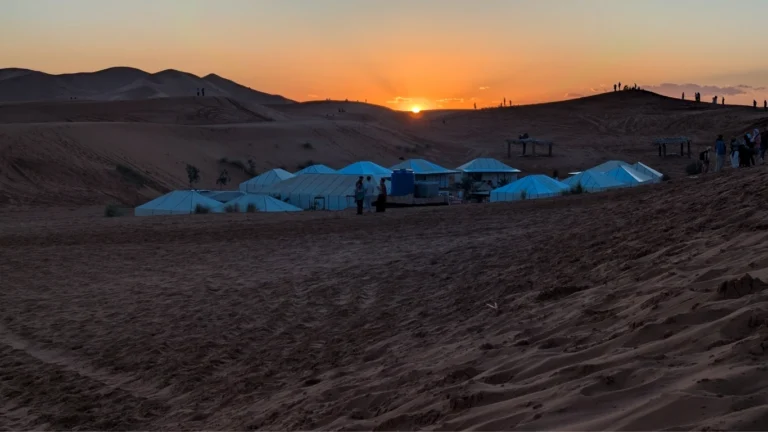
The tent made a loud noise all night — like it was about to collapse in the wind. It slept five strangers in a space that felt built for two. The bathroom had no lock. There was no toilet paper. At some point during the night, a group of loud teenagers joined the camp and made sleep impossible.
I’m not exaggerating any of this.
The difference between a $70 tour and a proper one isn’t luxury versus budget — it’s a functional experience versus a miserable one. A private or semi-private tent, a bathroom that locks, meals that are actually prepared, and enough space to sleep: these aren’t upgrades. They’re the baseline.
Don’t book anything under $120 per person for a 3-day tour — and if you’re going for 4 days, which I recommend, budget $150–200. The Sahara deserves better than a $70 shortcut. And after 10 hours in a car to get there, so do you.
The One-Sentence Summary
Drive with Waze, pack a warm layer and motion sickness supplies, ride the camel once, wake up for sunrise, and book 4 days with a proper camp — not 3 days with the cheapest option on the page.
Now you know what the itineraries skip.
Want everything in one place before your trip? The Marrakech Made Easy guide (10 pages) covers transport, desert tours, riads, scams, and every local detail that saves you money and stress from day one — all in 10 pages.

Si je loue une voiture, qu’est-ce qui est le plus près du Sahara et qui mérite d’être visité?
Bonjour ! C’est une excellente question. Si vous louez une voiture à Marrakech, votre choix dépendra entièrement du temps dont vous disposez. Voici les deux meilleures options :
1. Zagora (Désert de pierres et d’action) – À 5-6 heures de route :
C’est le désert le plus proche de Marrakech. La route pour y aller est tout simplement spectaculaire : vous traverserez le célèbre col du Tizi n’Tichka, et vous pourrez vous arrêter pour visiter la magnifique Kasbah d’Aït-Ben-Haddou (classée à l’UNESCO) et Ouarzazate. C’est l’option idéale si vous n’avez que 2 jours à consacrer au désert. Pour voir les grandes dunes de sable, il faudra pousser un peu plus loin vers M’hamid (Erg Chigaga).
2. Merzouga (Les dunes géantes de carte postale) – À 9-10 heures de route :
Si vous avez au moins 3 jours, c’est l’expérience saharienne ultime. Les dunes de l’Erg Chebbi sont gigantesques et d’un orange doré incroyable. Sur le chemin, vous devez absolument vous arrêter pour visiter les magnifiques Gorges du Dadès et les Gorges du Todra. La route est entièrement goudronnée et très facile d’accès, même avec une petite voiture de location.
Conseil de local : Si vous n’avez qu’une seule journée et que vous voulez juste voir des paysages lunaires sans faire 8 heures de route, le désert d’Agafay est à seulement 45 minutes de Marrakech !
Pour trouver les meilleurs tarifs et réserver votre voiture sans caution, vous pouvez aussi regarder ici :
https://localrent.tpm.li/X306JqTQ
Bon voyage !
Ayoub